A Roof Job in Order, From Old Shingles to Ridge Cap: What Each Step Is For
A new asphalt roof goes on in a set order, from tear-off to the ridge. This read follows that order with the Department of Energy, FEMA and UMass sheets beside it, so each line on a quote has something to be read against.
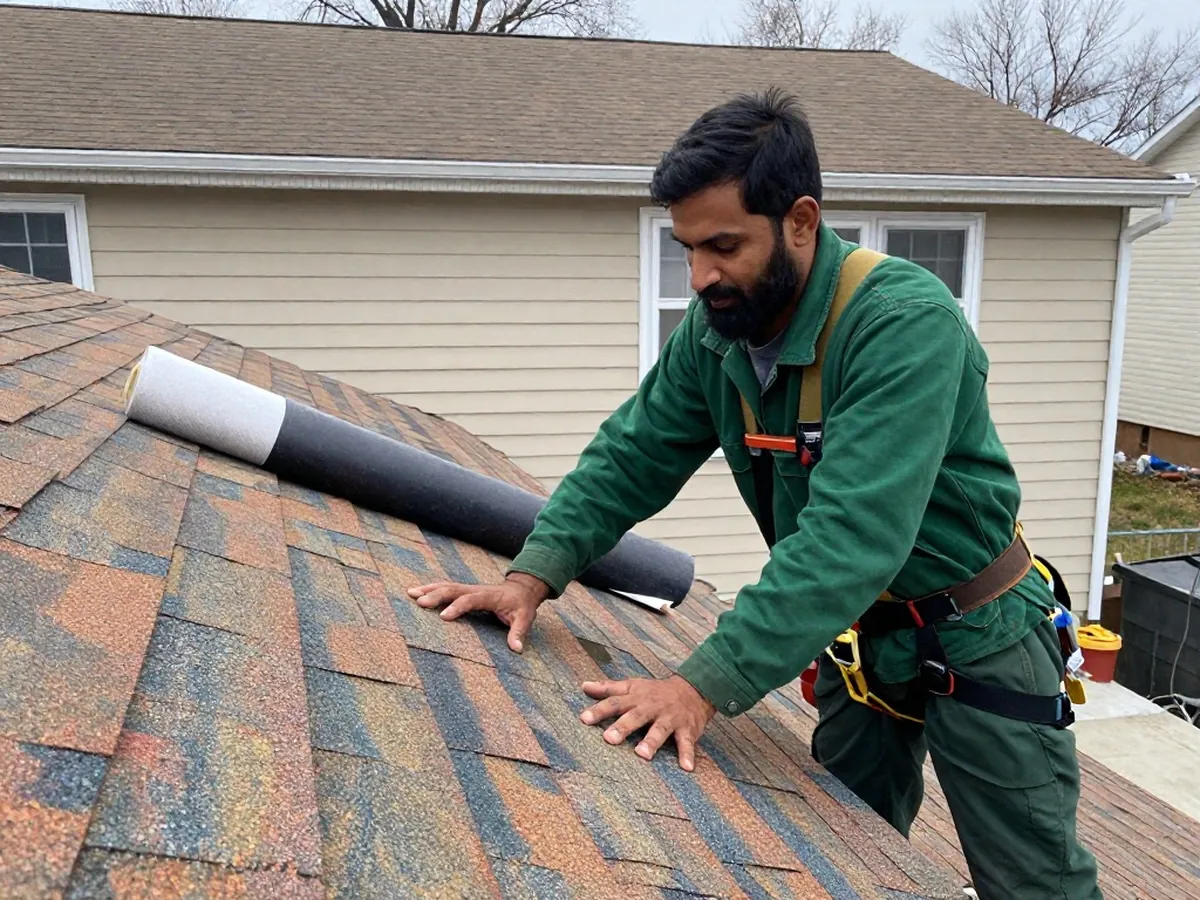
Tear-off: how far down does it go?
The Department of Energy's repair brief takes roofing off down to the sheathing in damaged areas and pulls out soaked fiberglass or cellulose insulation. It also passes along a Journal of Light Construction field-guide rule of thumb: past ten percent of the old roof in need of repair, the recommendation is a new roof. Whether a quote strips the whole roof or only the worst slope is a line to read before signing. The brief does not say how many layers of shingles a roof can carry; it leaves that to local code and a roofing professional. It warns that homes built before 1978 may contain lead paint and homes older than 1977 may have asbestos in roofing and insulation. The Census puts about 71 percent of Colonia's homes before 1970.
The deck gets a second look
Where only part of the sheathing is damaged, the brief replaces it with panels of the same thickness. For a full replacement it specifies decking rated 32/16 and at least 5/8 inch thick, nailed with 8d annular-shank nails 6 inches on center. It warns that overdriving nails can significantly reduce uplift strength. It sets wood at below 20 percent moisture before anything is laid over it. Those figures are what a quote's decking line can be measured against.
Underlayment, the layer no one sees afterward
The brief names three underlayment choices: one layer of 30-pound felt, two layers of 15-pound felt, or a peel-and-stick membrane, which it says reduces water intrusion if shingles are lost and is widely used in valleys. Ice-and-water shield over the whole deck is another option; the brief then drops the felt and says the attic has to be vented. FEMA's shingle sheet is shorter: always use underlayment. The Newark gauge averages between 2.98 and 4.66 inches of precipitation in every month, so no month is a dry one for a roof with its deck exposed. A quote that names the product and where it runs is easier to compare than one that says only felt.
From the first photo to the last receipt
Photograph the roof and any stains from the ground, with the date
Gather the roof's age and any earlier invoices
Call (732) 568-2812 and describe what you see
Have the roofer look at every slope and at the attic side
Ask how far the tear-off goes and what goes under the shingles
Compare quotes line by line: decking, underlayment, nails, flashing and vents
Read the written contract before signing, and put every change in writing
Keep children and pets clear of the yard under the roof while the old shingles come off
After the first sunny day, look from the ground at the new roof for straight lines and sealed tabs
Keep the contract, the receipts and any inspection papers together in one folder
Starter strip, nails and the sealing strip
FEMA's sheet calls for roofing nails, not staples, long enough to reach the underside of the sheathing or go at least 3/4 inch into planking. In its drawing, each shingle at the eaves carries six nails. The starter strip is a shingle with its tabs cut off, set 1 to 2.5 inches from the eave, with 1 inch preferred when the framing allows. After sun exposure activates the sealant, the tabs are checked to see that they have sealed. Where seal strips are absent, the sheet asks for interlocking shingles.
Ridge, hips and rakes, then the vent
At hips and ridges, FEMA's sheet puts a fastener on each side of the ridge, with longer nails if the shingles are thick there. It adds four 1-inch dabs of roof cement on the field shingle, and at rakes two dabs on the metal drip edge. The Department of Energy's brief favors baffled ridge vents, and vents set off the ridge, since unbaffled ones can let wind-driven moisture into the attic. UMass pairs a baffled ridge vent with continuous soffit vents so that air runs from eave to ridge.
The paper that comes with the roof
The contract rule in the state's administrative code, section 13:45A-16.2, calls for a signed, written contract that names the work, the total price and the dates work starts and ends. Changes are written down, permits are obtained before work starts, and the contractor cannot demand the final payment until the work is complete. A federal three-day cancellation rule covers many sales made at the home. The state's 2018 notice on ordinary maintenance covers replacing roof covering, in any amount, on houses of one or two families that share no wall with another building, though the work is still held to code compliance. The state's codes page lists the 2024 editions, adopted 17 August 2026. More detail is under Papers to ask for.
Which step of your own roof is the one in doubt?
If the old shingles are curling and the leaks keep coming back, the roof replacement page lists what a visit looks at. The roof repair page covers a smaller job. Write down the roof's age and where the water shows, then call (732) 568-2812 and go through each step above in the order the roof will go on. On the day itself, the one part a homeowner can watch from the lawn is the ladder. NIOSH's guidance is a 75-degree angle, three points of contact and a top that stands 3 feet above the roof edge.
Notes from the sources
- U.S. Department of Energy, Repairing Roofs and Ceilings technical brief
- FEMA, Technical Fact Sheet No. 7.3, Asphalt Shingle Roofing for High-Wind Regions
- UMass Amherst Building and Construction Technology, Preventing ice dams (P. Fisette)
- Cornell LII, N.J.A.C. 13:45A-16.2, home improvement practices
- Federal Trade Commission, Cooling-Off Rule
- NJ Department of Community Affairs, Ordinary maintenance and minor work alert (March 2018)
- NJ Department of Community Affairs, Current Construction Codes table
- NOAA NCEI, 1991-2020 monthly normals, Newark Liberty International Airport (USW00014734)
- NIOSH, Ladder safety (CDC archive, reviewed 1 March 2024)
- U.S. Census Bureau, ACS 2020-2024 5-year, table B25035 (median year built), Colonia CDP
- U.S. Census Bureau, ACS 2020-2024 5-year, table B25034 (year structure built), Colonia CDP
Checked 1 Nov 2026